

New sites are scarce.
Good wind sites are rare, flat land is taken by homes and farming, and ever-larger turbines are harder to move up a hill.
WindNext puts fixed rows of modular wind turbines along your ridge crest, in the clear space beneath your turbines' blades. Plan them into your repowering and get more energy from the land, roads and grid connection you already have. No new land, no new towers. Certified safe for birds. Zero infrasound.
Your hill farm sits on one of the best wind resources in Europe, and you have already paid for the hardest parts: the permit, the roads, the land agreements and the grid connection. Yet the turbines use only the upper part of the wind. The layer near the crest, below the blade tips, produces nothing.
Repowering makes the gap bigger. Many low turbines are replaced by fewer, taller ones, so the lower layer is cleared and left empty, while the grid connection you fought for may end up underused.
Meanwhile, new capacity is getting harder to add:
Good wind sites are rare, flat land is taken by homes and farming, and ever-larger turbines are harder to move up a hill.
Communities object to infrasound and bird deaths. Wildlife conditions in new permits mean curtailment: German law requires operators to accept bird-protection curtailment of up to 8% of annual yield.3
ESI Energy (NextEra), US, 2022: $1.86M fine plus $6.21M restitution for eagle deaths at 50 facilities.1 Aumelas (EDF Renouvelables), France, 2025: €5M in fines (half suspended) and 31 turbines stopped for 4 months.2
About 20 years, then replacement, with fibreglass blades that are almost impossible to recycle.
Sources: 1 US Department of Justice 2022 · 2 franceinfo 2025 · 3 BNatSchG §45b
WindNext is a modular multi-rotor wind turbine designed for hills. Instead of one giant rotor on a tall tower, it uses rows of small modular turbines fixed in place along the ridge crest, in two stacked rows. The rows reach about 43.7 m, so they fit in the clear space beneath the blades of large turbines.
Rotors of 17.4 m, about 135 kW each, with hubs at 18 m and 35 m. The rows follow the ridge line.
The rows don't yaw. Cross-ridge wind is caught from both sides of the crest, so a single row works whichever way the prevailing wind blows across the ridge.
The shroud is designed to enhance the jet effect. Rotors close together increase the yield of each one. Wind arriving at a ±30° angle increases yield by up to 35%.
95% of each module is made of only four parts: hoop modules, crossbar holders, shroud envelope parts and blades. The biggest segment is 1.5 × 11.3 × 2.2 m and weighs 2.3 tonnes, so it travels on smaller trucks and goes up with smaller cranes on your existing roads.
Repowering clears the lower 45 metres of your ridge. WindNext puts them to work.
Add 15,500 MWh a year per km of ridge (estimated, average case).
Many repowerings keep the same grid cap. WindNext adds MWh through the export capacity you already have, and where there is headroom there is no new grid application to wait for.
The rows sit on the existing crest strip, below the blades, at about 43.7 m. No new tall structures on the skyline.
Low, fixed and visible. Certified safe for birds. Zero infrasound. Small foundations and less soil work help planning permission move faster.
Small components, smaller trucks and cranes. No oversized blade transports up the hill.
Designed to last up to 60 years with scheduled maintenance, three times the life span of legacy turbines.
Designed to withstand extreme winds over 300 km/h.
When you repower, you rewrite the layout of your site anyway. Taller hubs and longer blades lift the rotors away from the crest and clear the lower layer. That is exactly where WindNext works.
Design both layers in one go: the big turbines above, WindNext rows below, in one layout, one permit process and one connection plan. You keep the roads, the land agreements and the grid connection, and you add MWh that the new layout would otherwise leave on the table.
65 GW
of Europe's wind fleet will be over 20 years old by 2030.
Source: WindEurope, 2026 (forecast).
An average new onshore turbine has a 146 m hub and a 151 m rotor, so its lowest blade tip sits at about 70 m. The layer from about 9 to 44 m above the crest stays empty, and that is where WindNext works: frame 2 shows the empty lower layer, frame 3 the WindNext rows in it, as in the ridge elevation under How it works. Where tip heights are capped, the gap is smaller, so every site starts with a clearance check.
Source: Deutsche WindGuard, average of 2025 installations; tip height derived.
We check geometrically that your existing or planned blades leave room for WindNext rows at the base of the farm.
We place WindNext rows into your repowering layout and check grid headroom and the lease of the crest strip.
A study on one of your sites leads to a first WindNext installation. First projects in 2028.
Also works without repowering: where today's blades already leave enough clearance, WindNext rows can be added to an operating farm. One of our first pilot projects is an expansion of an existing wind farm.
Check my siteper km of ridge crest (typical range 4,000-26,000)
| Mean wind | MWh/year per km |
|---|---|
| 6 m/s | about 11,600 |
| 7 m/s | about 16,500 |
| 8 m/s | about 21,500 |
* WindNext screening, Oct 2026, based on OpenStreetMap, Copernicus DEM, ERA5 and Global Wind Atlas data. Screening-level and indicative; every site needs its own check.
Is your wind farm one of them? See the indicative extra MWh for hill and ridge wind farms across Europe on our map. Per-farm figures are often lower: usable crest is usually a few hundred metres.
Find your wind farmLegacy rotors are nearly invisible and turn with the wind, so birds have no constant obstacle to learn. WindNext rows are fixed in place with an obvious shroud, a constant obstacle that birds see and avoid. WindNext turbines are certified safe for birds.
Certified safe for birds. Zero infrasound.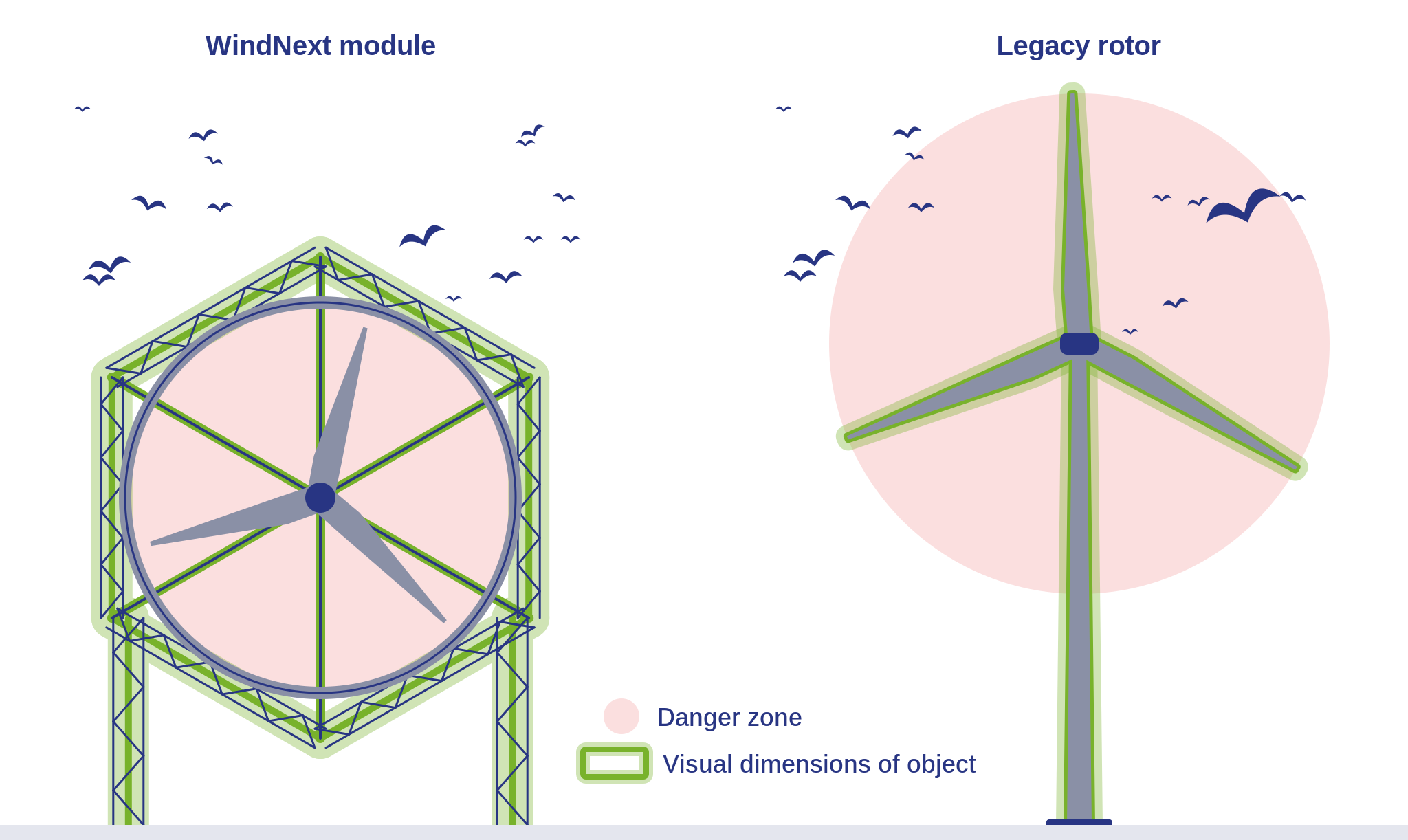
In legacy turbines, high-speed blades pass a large tower and create strong pressure waves: infrasound that can cause chronic noise stress in neighbours. A 2026 full-scale test by DTU and NREL on a 1.5 MW turbine measured an impulsive load of 100–150 N/m on the tower each time a blade passed, and found that these pressure swings likely contribute to low-frequency noise. WindNext has no tower in front of or behind the blades. Its rotors turn at 12 to 60 RPM, so they cannot create sound below 20 Hz. Zero infrasound, by design.
Source: Madsen et al., Wind Energy Science 11, 3337–3357 (2026)
We believe that the WindNext modular turbine design lowers the risk of collisions with birds, as the frame represents a visual barrier enabling the larger birds to see the obstacles.Birdlife society of Slovenia (DOPPS)
Wildlife and noise are where permits stall and where curtailment and fines come from. A low, fixed, visible turbine without infrasound gives your EIA team and the community a different conversation.
Our pilots include bird monitoring with DOPPS (BirdLife Slovenia) and local BirdLife partners, plus acoustic and infrasound measurements, and we will publish the results.
A legacy turbine is replaced after about 20 years, and its fibreglass blades usually end up in landfill or an incinerator. WindNext is designed to last up to 60 years with scheduled maintenance: one WindNext installation covers the life of three generations of legacy turbines.
All parts except the generator and electrical equipment are galvanised steel and aircraft-grade aluminium. The blades are fully recyclable too. At the end of its service life, the module goes back into the material cycle.
Small parts mean smaller foundations, less soil work and fewer heavy transports up the hill, so the build itself leaves a lighter footprint on the ridge.
Swipe to see the full timeline →
Every site gets a geometric clearance check first, so the rows stay in the clear space beneath your blades. The pilot measures wake and turbulence interaction with your existing rotors using lidar.
It depends on your ridge, its wind and the length of crest available. Estimated, average case: about 15,500 MWh a year per km of ridge (typical range 4,000-26,000), with about 15 MW installed per km (about 115 rotors). By mean wind at 35 m hub: 6 m/s about 11,600, 7 m/s about 16,500, 8 m/s about 21,500 MWh/year per km. At existing farms the usable crest is often only a few hundred metres, so see the wind farm map for per-farm figures. Your site study gives an indicative yield range; the pilot verifies the power curve to IEC 61400-12-1.
WindNext is designed for ridges where most of the wind blows across the crest. The rows take wind from both sides, and wind arriving at a ±30° angle increases yield by up to 35%. Our screening found 772 of 2,251 hill and ridge wind farms in the EU-27 and UK with this cross-ridge wind.
That depends on the country and on your existing permit. The best route is to design WindNext into your repowering permit. Smaller foundations and less soil work help planning permission move faster.
That is the plan. EU rules (RED III) cap the permit process for repowering at one year, or six months in renewables acceleration areas. WindNext is designed to go into the same permit application and environmental assessment as your new turbines, with no separate process. National rules still differ, so we check the route for your site in the site study.
Yes, that is the idea: more MWh through the connection you already have. We check the headroom in the site study. Where the connection is full, WindNext can be paired with storage or curtailment scheduling.
Type certification is under way and the type certificate is planned for 2028, together with first deliveries. Pilots include independent power-curve measurement. WindNext turbines are certified safe for birds.
First projects in 2028: site studies, pilot agreements and first deliveries.
WindNext rows are fixed and visible, certified safe for birds and produce no infrasound: there is no tower in front of or behind the blades, and the rotors turn at 12-60 RPM. Pilots include bird and infrasound monitoring.
Regulators worry about open blade tips sweeping close to the ground, where birds such as harriers hunt. WindNext is different: each rotor turns inside a fixed shroud and frame that birds see as a solid obstacle, the rows never move or yaw, and the rotors turn at only 12 to 60 RPM. Certified safe for birds. Every site still gets its own wildlife assessment, and our pilots include bird monitoring with published results.
Modules are assembled on site from small components. The biggest segment is 1.5 × 11.3 × 2.2 m and weighs 2.3 tonnes, so smaller trucks and cranes do the job on existing access roads.
WindNext is designed to withstand winds over 300 km/h. Icing on crests is part of the pilot measurement plan.
Maintenance by WindNext with local service partners. Service is designed for a 60-year asset.
Tell us about your hill wind farm. We reply within 5 working days with a first view on whether WindNext fits.